

Nowadays, politicians and commentators in Norway increasingly speak about issues such as immigration, economic value, hijab, integration, crime, and social cohesion.
But there is one common pattern in many of these debates:
immigrants and more specifically, Pakistanis and Muslims are repeatedly placed at the center of political frustration.
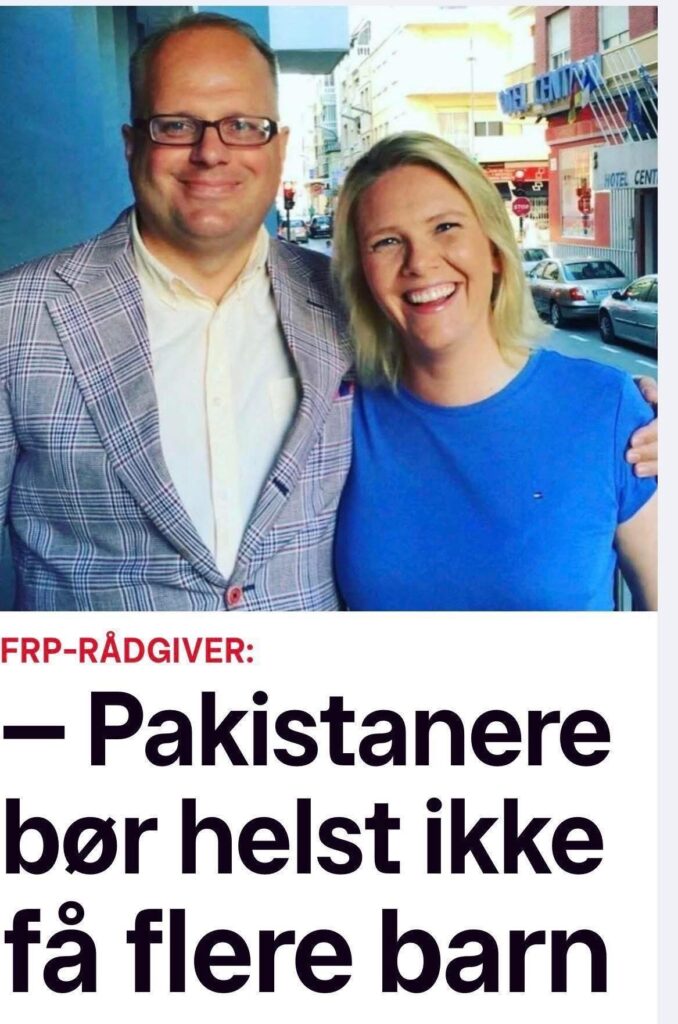
A recent example was when former FRP adviser Hårek Hansen used the term “Minus variants” while discussing Pakistanis.
That raises an important question:
How did an entire group of people suddenly become viewed mainly in terms of economic value?
“How much do they cost?”
“Do they contribute enough?”
“Are they profitable for society?”
That kind of language should concern everyone not only immigrants.
Because once human beings are reduced to economic calculations, society begins to lose something essential: empathy.
Norway did not become modern and wealthy in isolation. Migrant labor was also part of that story. During the 1970s and 1980s, Pakistani workers arrived long before Norway became the oil-rich country people know today. They worked in factories, transport, cleaning, restaurants, and industrial jobs that helped build the economy during decades of growth.
Those who are often described as a “problem” today also played a role in building the strength and development of society. It is surprising how easily history is forgotten, and how prosperity can sometimes affect people’s sense of perspective and gratitude.
That, too, is part of Norwegian history.
At the same time, Norwegians themselves once emigrated in massive numbers because of poverty and lack of opportunity. Around 800,000 Norwegians moved to America in search of work and a better future.
Nobody today describes those Norwegians as parasites.
Nobody says they invaded another society.
People understand that they were human beings trying to improve their lives and create opportunities for their children.
So why does migration suddenly become morally suspicious when the migrants are Muslims?
Ofcourse immigration creates challenges.
Integration problems exist.
Crime exists.
Social tensions exist.
These issues should absolutely be discussed honestly.
But honest discussion becomes impossible when entire communities are reduced to stereotypes.
It is easy to blame entire groups. Meaningful discussions, however, require facts, nuance, and equal standards.
Millions of immigrants including Pakistani Muslims in Norway contribute to society every single day through work, education, healthcare, transport, and business. There are countless success stories of immigrants, especially Muslims and Pakistanis, who have integrated into Norwegian society and contribute positively in many different fields.
At the same time, human value should not depend only on visible success, income, or public recognition. Every human being deserves equal dignity and respect.
If one immigrant commits a crime, suddenly millions are expected to explain themselves.
If one Muslim extremist appears, Islam itself is blamed.
Muslims are not “the problem,” just as Norwegians cannot be judged based on the actions of a few individuals.
However, there is another important issue in public debate today. When ethnic Norwegians raise concerns about racism, discrimination, or social problems, the discussion usually focuses on the issue itself.
But when Muslims or minorities raise similar concerns, attention often shifts toward their identity, religion, or background instead of the actual issue being discussed.
Is there also a lack of balanced debate in Norway about how incidents are framed? For example, when a Norwegian commits a crime against a Muslim, it is often described simply as “murder,” rather than being labeled or politicized in the same way as terrorism or identity-based framing that sometimes appears in other contexts.
Or has public debate gradually become more focused on Muslims especially Pakistanis in a way that leads to their contributions, skills, and broader identity being overlooked or narrowly categorized, particularly in discussions around racism and discrimination, ultimately shaping a social environment where certain groups feel more scrutinized than others?
That difference in treatment is increasingly noticed, especially by younger generations who feel they must first justify their belonging before their voice is taken seriously.
One person’s crime should never be used to label an entire community.
We are witnessing how Norway shows double standards in the Tamima case. When it comes to concerns involving Muslims, the narrative can shift in a way that changes public framing of incidents, even when the accused has accepted responsibility for the act itself.
Reactions in cases like Tamima’s have also raised questions about how similar incidents are discussed in public debate. Some immigrants and Muslims may now feel they must live more cautiously, constantly aware that one incident can suddenly turn their identity into a national discussion.
Should Muslims or immigrants rethink going out for work or daily life after incidents like Tamima’s, fearing that something similar could happen to them again?
Do we really want a society where people feel unsafe or constantly cautious because of such incidents?
Is that the kind of environment we want for the next generation?
These issues should be discussed openly but with fairness, balance, and without turning entire communities into scapegoats.
All of this has a deep impact on younger generations who increasingly feel pressure to constantly prove their identity, belonging, or loyalty in Norway.
As I asked in my previous article, I still ask the same questions today:
Can citizens with minority or Muslim backgrounds participate in public debate without first defending their loyalty?
Can power be criticized without the critic’s identity becoming the headline?
Will the next generation inherit a democracy where belonging is assumed or one where it must constantly be proven?
A healthy society should be careful with the mindset of dividing people into “valuable” and “less valuable.”
History shows that once societies begin ranking human beings according to usefulness, empathy slowly disappears.
Criticizing policies is legitimate.
Discussing integration is legitimate.
But dehumanizing entire populations is not.
Hate-driven rhetoric and divisive language do not strengthen society they only deepen fear, mistrust, and polarization between communities.
Today the target may be Muslims or immigrants.
Tomorrow it could easily become another minority.
A strong society is not built by teaching people to fear entire communities.
It is built by treating people equally regardless of religion, background, or ethnicity. No one is asking Norway to “owe” immigrants gratitude. But basic recognition, fairness, and mutual respect strengthen social trust and create a healthier society for everyone. Even a small appreciation between people can build stronger relationships within society and create a more positive and healthier environment for everyone, without judging identities first.
In the end, societies become stronger not by dividing people but by recognizing their shared humanity.
From,
Anam Hayat
Leave a Comment