

Europe often presents itself as a stronghold of religious freedom, and Norway is no exception. Yet, when one looks more closely at everyday realities, a more complex question begins to emerge: is that freedom equally experienced by everyone?
Walking through the streets of Oslo, women wearing the hijab are a familiar part of daily life. They move through public spaces without interruption, contributing to a picture of an open and inclusive society. But this image, while reassuring, is not the whole story.
When it comes to face coverings such as the burqa or niqab, the tone often shifts. While there is no blanket nationwide ban in public spaces, these forms of dress continue to be the subject of public discussion and debate. This raises an important question: why do discussions around visibility and integration so often center on Muslim women’s choices?
This is where a more subtle dynamic begins to take shape one of framing.
In media and political discourse, Muslim identity is frequently discussed through the lenses of security, integration, and “shared values.” Over time, such framing can shape public perception, creating an environment where some forms of religious expression are more widely accepted, while others tend to receive greater scrutiny even in the absence of outright legal bans.
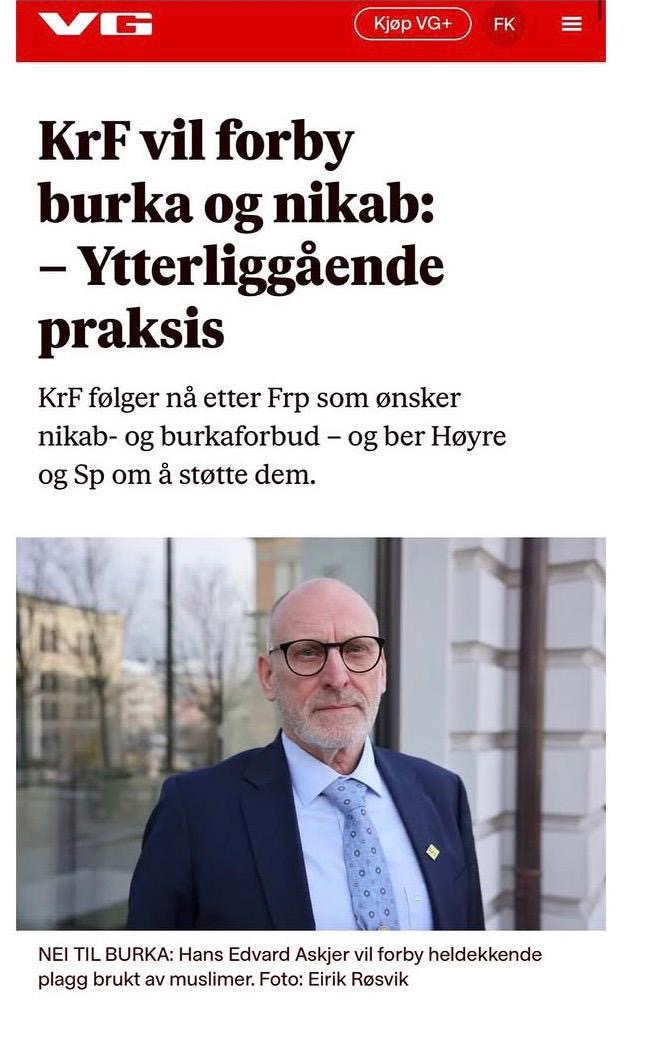
In recent days, this debate has taken a more direct political turn. Discussions within parties such as the Christian Democratic Party (KrF) have raised the question of whether burqa and niqab should face broader restrictions in public life. While no nationwide ban has been implemented, the very presence of such proposals reflects how Muslim dress continues to be a recurring subject of political discussion.
In contrast, countries like France and Denmark have taken a more explicit legal route, introducing nationwide bans on face coverings such as the burqa and niqab in public spaces. Norway often distinguishes itself from these approaches, and that distinction matters. However, laws alone do not define the boundaries of acceptance. Social attitudes often carry equal, if not greater, weight.
Islamophobia does not always appear in overt or aggressive forms. Some observers argue that it can also emerge subtly through discomfort, repeated scrutiny, or the need for constant justification. In some cases, members of a community may feel the need to explain their identity, their clothing, or their place in society, which may create a sense of pressure that is not always written into law but can still be felt in everyday life.
The real debate, then, extends beyond legislation. It is about the ideas that shape those laws and the narratives that circulate within society.
Norway’s story is still one of balance between freedom and limitation, acceptance and hesitation. But to understand that balance fully, one must ask a difficult question: can freedom truly be called equal if it depends on social approval?
This is not only Norway’s question. It is one that echoes across Europe.
Leave a Comment