

Norway prides itself on fairness, equality, and the rule of law. Democratic debate is supposed to be judged on arguments not on who is speaking. On paper, everyone is treated equally. But in reality, identity often ends up taking center stage.
In this context, the media plays a powerful role. It shapes how society understands issues and communities. Western media often amplifies negative stories about Muslims like hijab controversies, forced marriages, honor-related violence, or extremism. While such issues deserve coverage, the imbalance creates an overwhelmingly one-sided image. Over time, this shapes public perception. Prejudice becomes normalized, and young Muslims carry the mental and emotional burden of being judged before they are truly known.
We see this pattern repeatedly. When Muslim communities raise concerns or express opinions, the critique rarely focuses solely on the arguments. Instead, scrutiny often shifts toward identity. Visible minorities especially Muslims in leadership roles frequently face questions about their loyalty, intentions, or background rather than engagement with the substance of what they are saying.
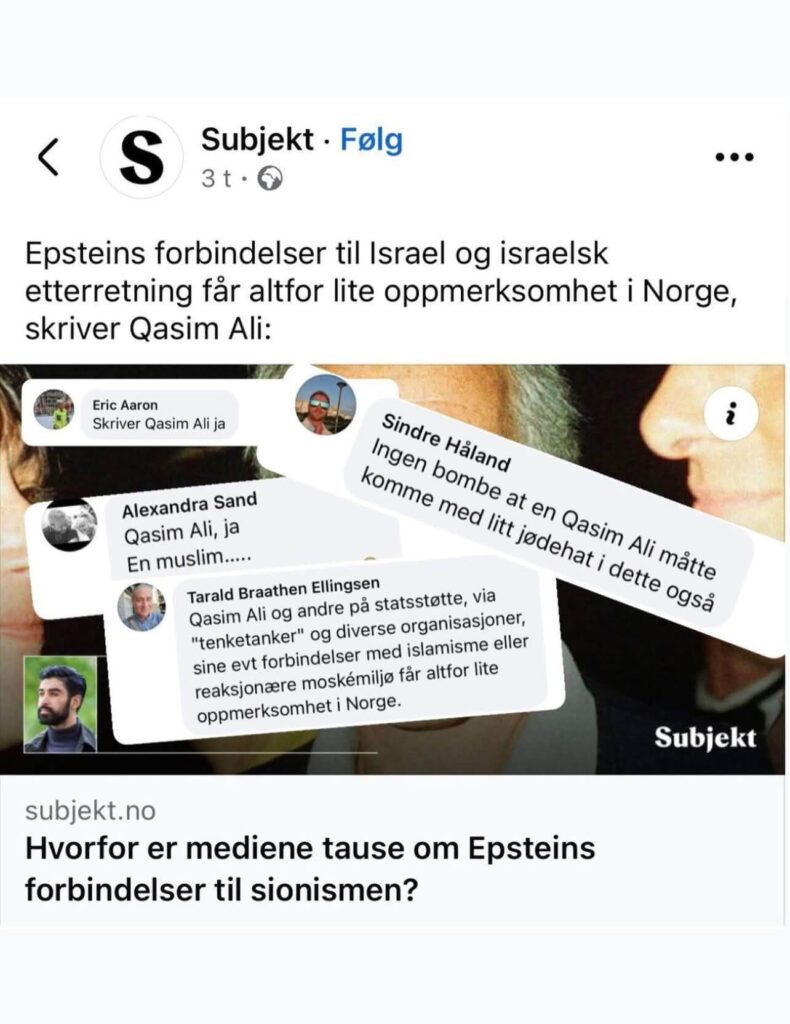
The recent example of Qasim Ali, leader of MINORG. When his article appeared in Subjekt.no, the reaction was not primarily about his arguments. Much of the focus centered on the fact that he is Muslim. He himself wrote:
“I see that some reactions are not directed at the content of my text, but at me as a person that I am Muslim and the leader of MINORG. I have no agenda against Jews. I am not a Jew-hater. Criticism of states, intelligence services, or power structures is not hostility toward a people or religion. MINORG receives no state funding. We have never received a single krone from the state, nor have we applied for it. The organization is 100% voluntary.”
This raises a critical question: must minority voices first prove their neutrality before their arguments are taken seriously? If raising concerns about justice triggers suspicion when the speaker is Muslim, why does the same reflex not apply across the board?
A Stark Social Media Contrast:
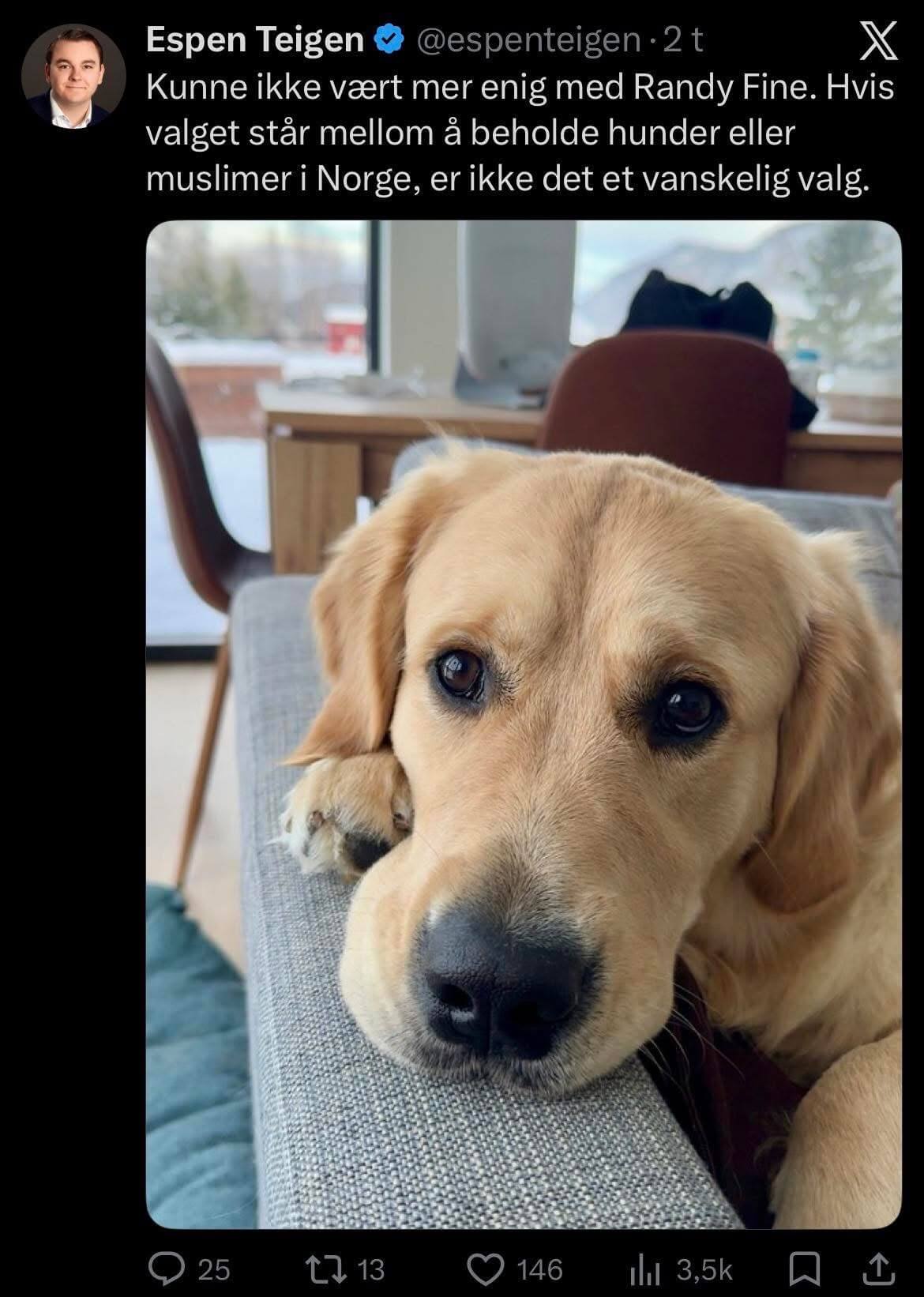
We don’t see the same pattern of fairness and equality when a disturbing contrast emerges when high-profile figures make inflammatory statements. when the direct target to islamophobia or racism shows in their social media posts. Like an example of the recent post of Espen Teigen stating:
“If the choice is between keeping dogs or Muslims in Norway, it’s not a difficult choice.”
The reactions to this post were mixed both negative and supportive. However, much of the online discussion focused on freedom of expression and Teigen’s “right to post,” rather than on the moral gravity of dehumanizing an entire religious community. Critically, no one questioned his identity, loyalty, or religious background.
The asymmetry is difficult to ignore. Minority voices face scrutiny for raising concerns, while majority figures often avoid similar scrutiny when their words demean entire communities. Does this not suggest a subtle form of discrimination?
Dehumanization is a core mechanism of racism. It frames an entire group as inferior or less worthy of dignity. History repeatedly shows where such rhetoric can lead. Debating policy is legitimate; questioning a community’s basic humanity crosses a moral line. Freedom of speech protects the right to speak but it does not remove accountability for racial or religious prejudice. Normalizing such language today risks normalizing division tomorrow.
Migration and Public Discourse:
The same framing pattern appears in migration debates. Visa regulations, border control, and integration requirements are legitimate policy discussions. But when migration is broadly associated with security risks, welfare burdens, or cultural instability, suspicion shifts from individual behavior to collective identity.
In reality, most migrants in Norway work, pay taxes, and contribute to society like other Norwegians. Our children attend the same schools. We work in the same offices. We live on the same streets. Migrants are not living separately from society they are part of it. Yet public narratives often make them seem like outsiders first.
The Impact on the Next Generation:
Young Norwegians with Muslim or immigrant backgrounds increasingly soften their identities, shortening names, downplaying religious expression, or avoiding controversial topics. This is not always a simple personal choice; it is often a response to a climate where visibility brings extra scrutiny.
But this is not about one article, one leader, or one community. It is about democratic consistency.
Can citizens with minority backgrounds participate in public debate without first defending their loyalty?
Can power be criticized without the critic’s identity becoming the headline?
Will the next generation inherit a democracy where belonging is assumed or one where it must continually be proven?
Fairness is meaningful only when it applies universally. Racism even subtle erodes trust, weakens institutions, and turns democracy into procedure rather than principle.
Being Muslim or from a minority background does not make someone a threat. We follow the rules and respect the law. We contribute to society and work to build bridges between communities for peace and unity. Norway’s future depends on holding everyone to the same standards where justice, not prejudice, leads the way.
Read in Norwegian: https://www.utrop.no/plenum/ytringer/378679/

Leave a Comment